
Where every meal comes with a story — and sometimes a reindeer standing nearby
Tromsø is not a city people usually visit for the food. They come for the Northern Lights, the husky sledding, the whales. But somewhere between arriving and leaving, almost every visitor ends up having a meal — sometimes by a bonfire at midnight, sometimes inside a Sami lavuu tent with snow on the roof, sometimes on a boat watching humpbacks break the surface — and realizes that eating in the Arctic is its own kind of experience.
The flavors here are not complicated. They are honest. Cold-weather food, made with ingredients that come from the land and sea immediately around you. Reindeer that grazed on lichen in the mountains. Wild salmon pulled from fjord waters. Cloudberries that ripen in the short Arctic summer and taste like nothing you’ve had before. And homemade soup served from a thermos at the back of a tour van at midnight, when the temperature is well below freezing and it is, genuinely, the best thing you have ever tasted.
This guide covers what to eat in Tromsø — on tours, in restaurants, at the market, and in the moments between.
The Food You’ll Find on a Northern Lights Tour
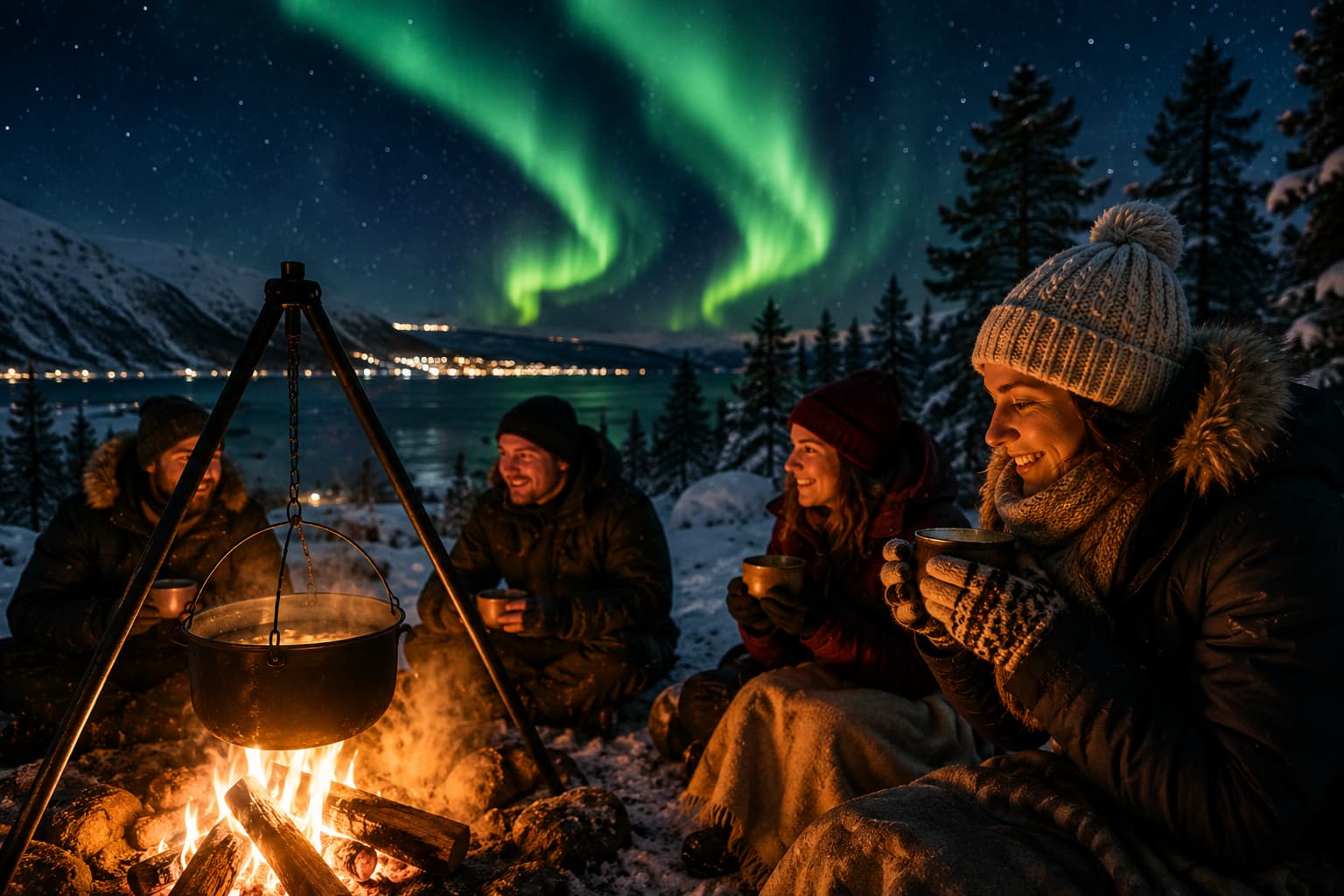
There is something specific that happens when you eat homemade soup at midnight in the middle of the Arctic wilderness while waiting for the aurora to appear. The cold makes you hungry in a way that ordinary cold doesn’t. The darkness makes the warmth of food more immediate. And the soup — usually a hearty fish or vegetable broth, made that day by the guide, poured into cups and handed around the bonfire — tastes disproportionately good.
Nearly every reputable small-group Northern Lights tour in Tromsø includes food as part of the experience. Not as an afterthought or a courtesy snack, but as something genuinely built into the evening. Tromso Norway Tours works with operators who include hot homemade soup, warm drinks, and a proper campfire stop as core inclusions — because guides who have spent hundreds of nights in the Arctic know that a cold, hungry traveler is a miserable traveler who misses the aurora entirely.
What you’ll typically eat on a Northern Lights tour:
Homemade soup — fish chowder or vegetable-based, hot and filling
Warm drinks — coffee, tea, or hot chocolate, served from flasks
Norwegian bread and crackers — often dark rye, handed out with butter
Cookies or light sweets — for energy during the wait
It sounds simple. It is. But eating soup beside a fire while green light starts moving across a sky so dark you can see the Milky Way is not a simple experience. It is one of the meals people remember years later.
Sami Cuisine: Food as Cultural Story
The Sami people are the indigenous inhabitants of northern Scandinavia, and their food tradition is one of the oldest continuous culinary cultures in Europe. In Tromsø and the surrounding region, several tour experiences offer genuine access to Sami food — not as a performance, but as part of a living tradition shared by the people who still practice it.
The centerpiece of Sami cuisine is reindeer. Reindeer have been central to Sami life for thousands of years — as transport, as income, and as sustenance. The meat is lean, deeply flavored, and prepared in ways that reflect a food culture built around preservation and long winters. At a Sami reindeer experience, guests typically gather inside a lavuu (a traditional tent) around a fire, and the guide serves a hot meal while telling the stories of Sami herding life, singing joik songs, and answering questions with a warmth that feels genuinely personal rather than scripted.
What you’ll typically eat at a Sami reindeer experience:
Reindeer stew — slow-cooked, rich, often served with flatbread
Dried reindeer — intense and chewy, like Arctic jerky
Traditional breads — often unleavened and cooked over open fire
Cloudberry jam — the crown jewel of Arctic preserves
Coffee or tea by the fire
The authentic Reindeer Sledding and Sami Cultural Journey offered through Tromso Norway Tours includes a traditional hot meal inside a lavuu with a Sami guide who runs the camp with 300 reindeer — a genuinely different experience from the costumed recreation versions of Sami culture that appear at some tourist sites.
The Wild Salmon Picnic at Sommarøy
This is one of the most unexpectedly wonderful food experiences in the Tromsø region, and it happens not in a restaurant but on a beach.
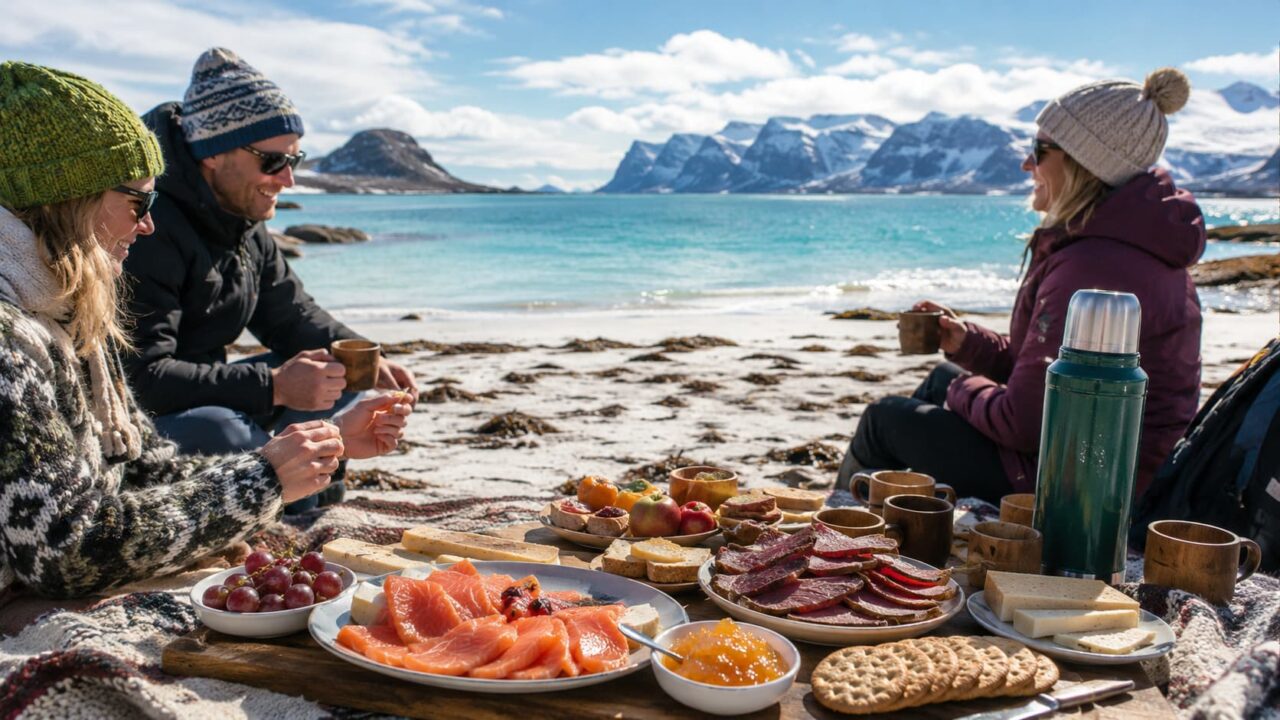
The Sommarøy Islands sit about an hour from Tromsø by bus, and they are, improbably, a place with white sand beaches and turquoise water in what is definitively the Arctic. The water is cold enough to take your breath away if you swim in it, which some people do. But the reason the Sommarøy island experience stays with visitors is often the picnic.
The meal is served on the beach: wild salmon, elk and reindeer meats, local cheeses, crackers, sweet cookies, fruit, coffee, and tea. The salmon — truly wild, from these fjords, not farmed — is a revelation if you have only ever eaten the farmed variety. It is firmer, more deeply colored, and has a flavor that tastes the way you imagine salmon is supposed to taste before supermarkets made it interchangeable.
Eating wild salmon on an Arctic beach with the water in front of you and mountains behind you is the kind of meal that recalibrates what you expect from food for a while after.
Norwegian Waffles: The Unofficial National Snack
Norway runs on waffles. Not Belgian waffles. Not American waffles. Norwegian heart-shaped waffles — softer, thinner, slightly tangy from the sour cream batter — served with jam and sour cream (rømme) or brown goat cheese (brunost).
You will encounter Norwegian waffles in multiple contexts in Tromsø:
At the end of an Arctic floating experience, served with hot tea to warm you up after time in the cold water
At cafés around the city as a mid-morning or afternoon staple
At cultural centers and visitor attractions as the default welcome offering
Brunost — Norwegian brown cheese — deserves its own mention. It is made from the whey of goat and cow milk, caramelized during cooking into a sweet, slightly savory brown block that tastes something like fudge and caramel combined. Norwegians put it on everything. Bread, waffles, crackers. First-time visitors are often suspicious of it and then quietly eat three slices.
Fish in Tromsø: What the Sea Offers
Tromsø is a fishing city first. The modern restaurant culture sits on top of a centuries-old relationship with the sea, and the best fish dishes in the city reflect that history rather than decorating it.
Stockfish (klippfisk or tørrfisk) is dried cod that has been a Norwegian export for nearly a thousand years. In Tromsø you can see stockfish hanging to dry on traditional wooden racks outside fishing operations, and in restaurants it appears in stews, salads, and as the base for traditional bacalao. The texture and flavor are nothing like fresh cod — intense, chewy, almost meaty.
Arctic cod — skrei — arrives in northern Norwegian waters from January through April, migrating from the Barents Sea to spawn. During skrei season, restaurants in Tromsø build menus around it. Fresh skrei with brown butter, capers, and flatbread is as simple and as good as fish cooking gets.
King crab deserves a mention. The red king crab is not native to Norwegian waters — it migrated from the Soviet Union side of the Barents Sea decades ago and is now a major catch in northern Norway. Its legs are enormous and the meat is sweet and dense. Several Tromsø restaurants serve it in various preparations; the most honest version is steamed and split with drawn butter.
Where to Eat in Tromsø
The restaurant scene in Tromsø is small by capital-city standards and excellent by Arctic standards. A few spots that align with what this city does best:
Arctandria — a Tromsø institution in a 19th-century dockside building. Arctic fish, stockfish preparations, and game are handled with precision and historical affection. Order the stockfish.
Helmersen — modern Nordic with serious technique. The menu changes with what’s available, and in a city at 70° North, what’s available changes dramatically by season.
Rorbua — casual and cozy, built inside an old fishing warehouse. Good fish soup, good fish cakes, the kind of place you could sit for two hours.
Ølhallen — not food-first, but Tromsø’s oldest pub, attached to the Mack Brewery since 1912. A glass of Mack Arctic lager in a room that has been serving fishermen and sailors for over a century is a genuinely atmospheric experience.
Kaffebønna — the local coffee chain that Tromsø residents actually use. Multiple locations, excellent coffee, and a place to sit and watch the city move on a winter afternoon.
For a complete list of Tromsø restaurants across categories — fine dining, casual, Asian, Italian, pizza, cafés, bars — the Tromsø food guide at Tromso Norway Tours covers the current landscape in useful detail.
The Polar Fishing Experience: Cooking What You Catch
For visitors who want to connect with Tromsø’s food culture at its most fundamental level, the polar fishing experience is worth knowing about.
The experience runs on a traditional wooden boat in the fjords around Tromsø. Guests try their hand at cod fishing with provided equipment, and if the fishing is good — which, in fjords with cod populations that have supported communities for centuries, it usually is — the freshly caught fish is cooked and served on board with butter and flatbread in traditional northern Norwegian style.
There is something satisfying about the directness of this. Water to fish to plate in the space of a few hours, on the water where it happened. It is not fine dining. It is better than that in its own way.
What to Bring Home from Tromsø
If you want to carry a piece of the food experience back with you:
Brunost travels well. Buy a block at a local grocery store (Rema 1000 and Kiwi are everywhere). It keeps at room temperature longer than you’d expect and is unlikely to survive contact with people who try it at home.
Stockfish is available dried at the market and in gift shops, and is a genuinely authentic piece of Norwegian food culture rather than a decorative souvenir.
Cloudberry jam — tyttebær (lingonberry) and multebær (cloudberry) — is worth hunting for. The cloudberry version especially, made from berries that ripen for only a few weeks in late summer and are hand-picked in the mountains, is something that does not exist in most food cultures outside Scandinavia.
Mack beer is the local brewery, established in 1877, and is the northernmost brewery in the world by a significant margin. The Arctic lager and the various seasonal releases are good, and the story behind them is better.
Final Thought
Tromsø’s food is not trying to impress you with complexity. It is trying to feed you in a place where the winter lasts eight months, the sun disappears for two of them, and the relationship between people and food is one of genuine necessity that became genuine tradition.
The soup by the aurora bonfire. The reindeer stew in the lavuu. The salmon on the beach. The waffles at the end of a cold swim. The stockfish in a room that has smelled like the sea for a century.
These are not Michelin moments. They are better in the way that honest food served in the right place at the right time is always better.
If you are planning a trip to the Arctic and want to know which tours include the food experiences described here — the Sami dinners, the bonfire soup, the salmon picnic, the polar fishing — Tromso Norway Tours is the most thorough resource available for comparing what’s included across operators before you book. The food is part of the tour. It is worth knowing what you’re getting before you leave home.
[For more food adventures from unexpected places, explore the articles and restaurant guides on this site.]
About the author: Written by a food and travel writer who has eaten soup by an Arctic bonfire and believes it was the best soup they have ever had. They stand by this.